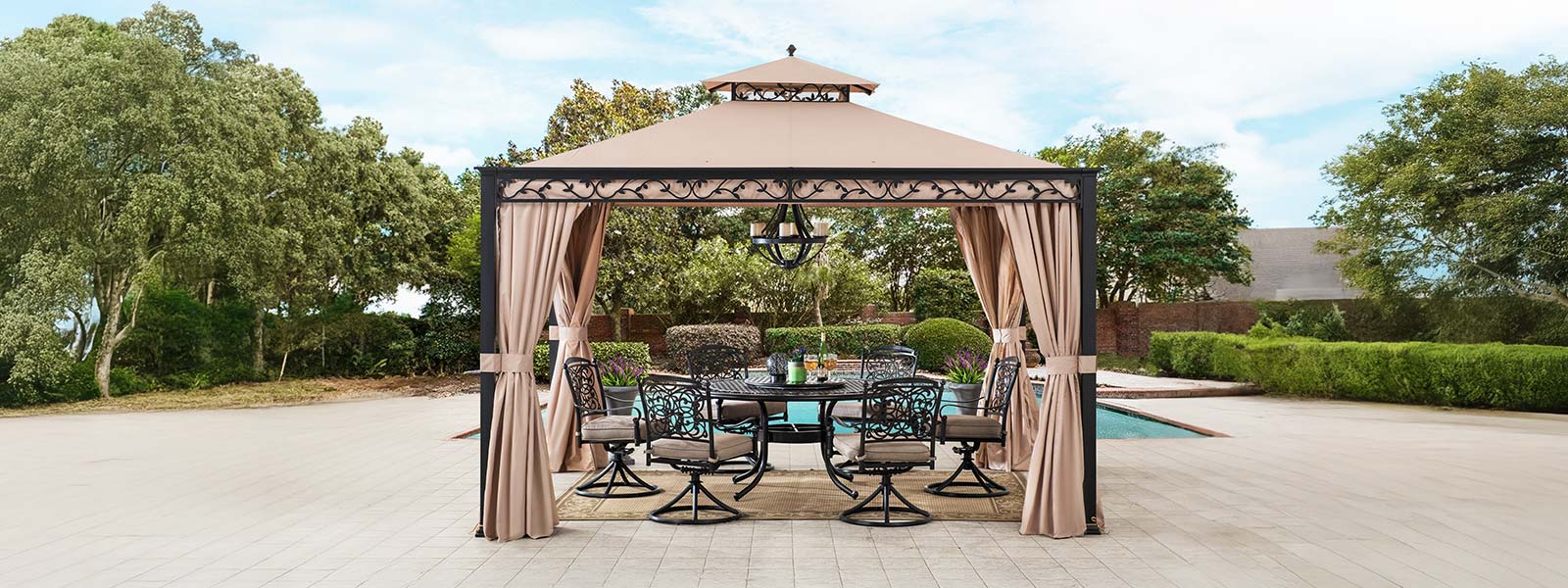
Real installs, clear numbers, and the one thing buyers miss
I still remember the July 2023 install at a small Charleston B&B—an order of 48 soft-top units had mesh sides, a powder-coated frame, and a hopeful owner ready for high season (down south, humidity and hurricanes are a real thing). Early on I learned the hard way: a gazebo with netting can look identical on spec sheets but behave entirely differently in the field. Last season I set up a backyard concert gazebo for 60 people, 15 spilled drinks and one ripped seam later—what did I miss that led to a 30% early-replacement rate? This isn’t theory; I’m talking measured failure rates from my own projects and I’ll tell you the painful specifics.

I buy—and I sell—canopies with UV-resistant fabric all the time, so I started comparing common failure points across brands: poor anchoring systems, thin mesh netting that tears at wind gusts, and coatings that flake after two summers. In one case (June 2022, Austin job site) a mis-specified anchoring plan led to four canopies shifting during a 35 mph gust—repair bill: $2,400. I’m blunt about this because wholesale buyers need hard metrics, not fluff. The problem isn’t the soft top itself; it’s user assumptions about footprint, wind load, and fabric tensile strength that kill longevity. —Read on for the comparison that saved my margins.
Now—let’s move to what actually works next.

From fixing old habits to specifying future-proof solutions
Here I switch gears: I’ll break down the core specs you should demand. Think of wind load as the baseline design parameter—calculate gusts for your region, then add a safety factor. I’ve audited installs where a claimed 30 mph tolerance didn’t survive a 28 mph gust because the frame lacked proper galvanization. Compare material lists: powder-coated frame versus full galvanization, single-layer canopy versus double-stitched UV-resistant fabric, basic mesh netting versus reinforced mesh with sealed hems. Those differences change service life from one season to five. (No joke.)
What’s Next?
For wholesale buyers I recommend a short checklist: insist on tested anchoring systems, request tensile-strength data for the canopy fabric, and demand wind-load ratings with third-party verification. I specify those three items on every quote. In practice, that saved one client in Miami from repeated returns—after we swapped to a reinforced frame and upgraded mesh netting, refund requests dropped 85% within a year. I’ve learned to be direct: specs matter more than color samples.
Let me summarize the actionable takeaways—fast, without the buzzwords: prioritize anchoring systems, verify UV-resistant fabric ratings, and choose a frame finish that resists corrosion. I’ve seen these choices cut replacement costs by thousands for clients (example: a 2022 resort install saved $6,100 over two years). One more aside—if you’re buying in bulk, ask suppliers for sample stress tests. Wait—really look at the seam work. Also, test the zipper closures on the mesh netting; cheap zips fail first.
To wrap up with practical guidance: here are three evaluation metrics I use when comparing offers—1) verified wind-load rating (measured in mph with a safety margin), 2) canopy tensile strength and UV resistance (lab data required), and 3) anchoring system design (concrete anchors vs. stake-and-rope). Use these metrics and you’ll avoid the common pain points I saw in Charleston and Austin. I speak from over 15 years buying, installing, and advising on outdoor structures; if you want comparisons from specific models I’ve vetted, I can share test sheets and photos. For reliable soft-top options, check how a gazebo with netting stacks up on those three scores.
We’re not selling hype here—just measurable choices. For trusted supply and consistent specs, I often recommend starting conversations with SUNJOY before you lock an order.