The Hook
Choosing among TOPCon solar panels brands is difficult because module efficiency is only one part of a long-term investment. Buyers also need to examine product documentation, temperature performance, degradation warranties, certifications, manufacturing controls, installation conditions, and the supplier’s ability to support a project after delivery. Brand names can indicate experience, but they do not replace a current datasheet or written warranty. This comparison evaluates three supplied brands—Jinkosolar, Jointsolar, and Loomsolar—using official company information where available and clearly separating documented capabilities from details that require confirmation. The options were reviewed against product scope, market coverage, materials, quality indicators, and likely application fit rather than promotional claims alone.
Full List of Top 3 Brands
- Jinkosolar — A global PV manufacturer with TOPCon products in its Tiger Neo portfolio.
- Jointsolar — An India-focused solar PV supplier and manufacturer whose stated scope includes residential, commercial, and industrial applications.
- Loomsolar — An Indian solar power systems and parts manufacturer founded in 2018, with reported export activity and a broad solar-product focus.
Comparison Table
| Brand | Key Products | Key Features | Best For |
|---|---|---|---|
| Jinkosolar | Tiger Neo n-type TOPCon PV modules | Documented TOPCon product family, global manufacturing and project reach, high-power module options, and published technical documentation | Residential, commercial, and utility-scale projects requiring a well-documented global module platform |
| Jointsolar | Solar PV modules and complete solar energy solutions | Stated focus on quality, sustainability, customer satisfaction, and residential, commercial, and industrial applications | Indian projects where local supplier capability and product-level TOPCon documentation can be confirmed |
| Loomsolar | Solar power generating systems and parts | Founded in 2018, research and development activity, two manufacturing units, and reported exports to more than 10 countries | Residential and distributed-energy buyers seeking a broader solar-system supplier |
Detailed Reviews
1. Jinkosolar
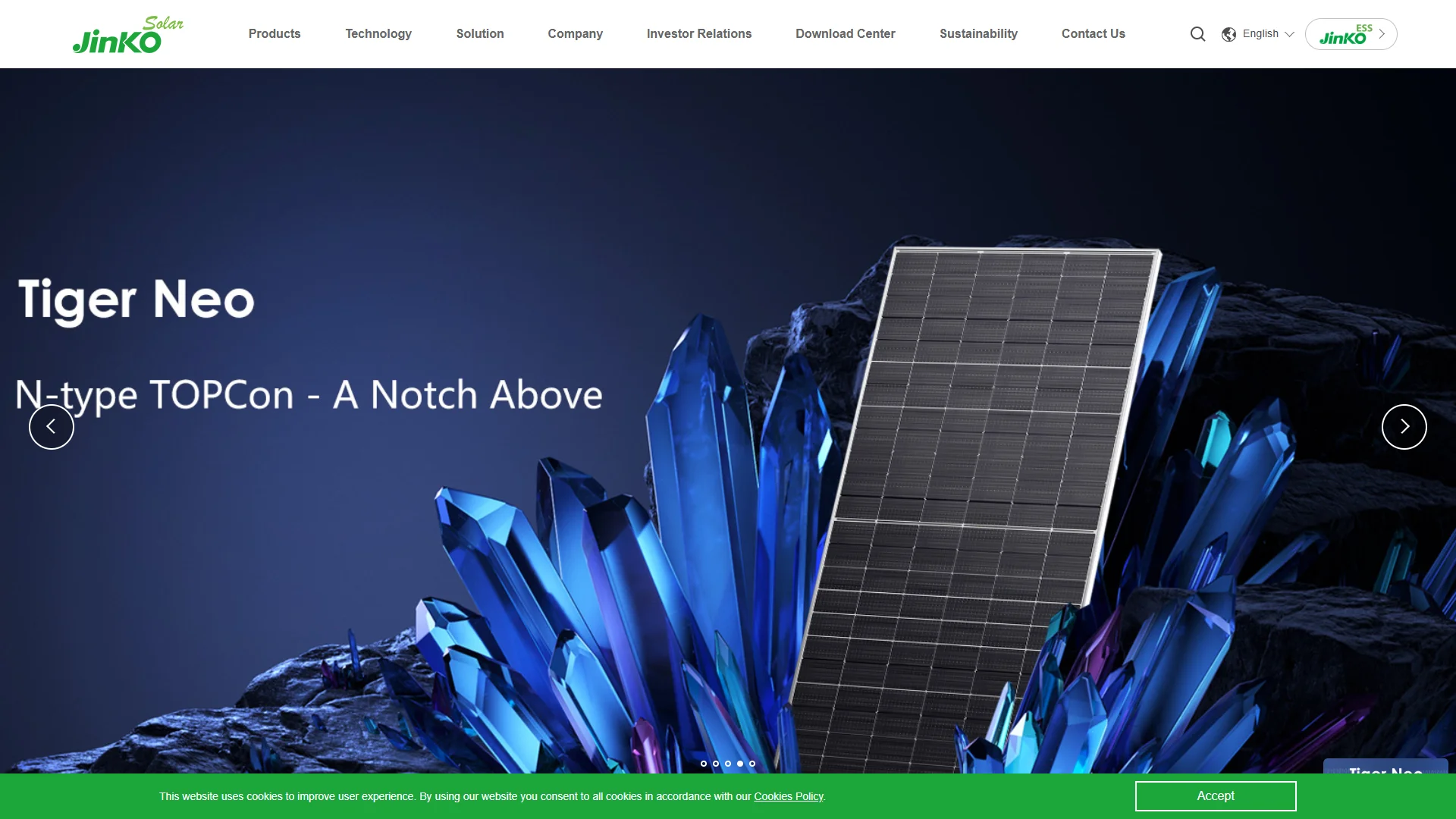
Jinkosolar is a major photovoltaic manufacturer with a broad international market presence. Its official product portfolio includes the Tiger Neo family, which uses n-type TOPCon cell technology. The company publishes product specifications and technical documentation for its module ranges, allowing buyers and engineering teams to compare electrical characteristics, dimensions, operating limits, and warranty terms at the model level. Because module specifications vary by generation and model, the current datasheet should be used for procurement rather than relying on a general series description.

Overview
Jinkosolar’s positioning is centered on large-scale PV manufacturing, product development, and deployment across residential, commercial, and utility applications. The Tiger Neo range is particularly relevant to a TOPCon comparison because it is presented by the company as an n-type TOPCon module platform. N-type cell architecture is commonly selected for its potential combination of high power density, strong energy yield, and reduced light-induced degradation, although the actual result depends on the specific module, climate, installation design, and system components.
Products and Materials
- Tiger Neo modules are the principal TOPCon product family identified for this comparison.
- Jinkosolar offers module variants with differing power ratings, dimensions, cell configurations, and electrical characteristics.
- Module construction uses solar cells, encapsulation materials, protective glass, and a structural frame; the exact glass, cell, and mechanical configuration must be checked in the model-specific datasheet.
- Published technical documentation supports evaluation of maximum system voltage, operating temperature, mechanical loading, connectors, dimensions, and performance warranty conditions.
Pros / Key Features
- Clear relevance to the TOPCon category through the Tiger Neo n-type product family.
- Broad manufacturing scale and international distribution can support larger procurement programs.
- Product documentation enables technical comparison between module generations and configurations.
- Suitable product range for different project sizes, subject to local availability and installer compatibility.
- Established global brand recognition may simplify lender, developer, and engineering due diligence, although acceptance requirements differ by project.
Use Cases / Best For
Jinkosolar is best suited to buyers seeking a documented TOPCon module platform for residential rooftops, commercial and industrial installations, or utility-scale developments. It is also a practical candidate when project stakeholders require a manufacturer with international distribution and model-specific technical literature. Purchasers should still confirm the exact Tiger Neo variant, local distributor, warranty issuer, certification requirements, mounting compatibility, and availability before placing an order.
2. Jointsolar
Jointsolar is presented in the supplied company research as an Indian solar PV manufacturer and supplier offering complete solar energy solutions. Its stated positioning emphasizes high-quality PV modules, sustainability, customer satisfaction, and support for clients seeking lower energy costs and reduced carbon footprints. The available research describes applications across residential, commercial, and industrial solar systems. It does not provide enough product-specific evidence to confirm that every Jointsolar module is TOPCon, so buyers should request a current TOPCon datasheet and written product documentation for the intended model.
Overview
The company’s stated scope includes solar modules and broader solar-energy solutions. The supplied research references silicon-based solar construction, protective glass, encapsulation layers, and frames, which are standard elements of conventional PV modules. It also refers to quality and sustainability priorities, but model-level information such as cell architecture, rated efficiency, degradation rate, and temperature coefficient should be verified directly with Jointsolar.
Pros / Key Features
- Positioned as a supplier of solar PV modules and complete solar-energy solutions.
- Stated application coverage includes residential, commercial, and industrial projects.
- Research materials identify quality, sustainability, and customer satisfaction as company priorities.
- References to certifications such as IEC, UL, or BIS should be checked against the specific module and certificate number.
- After-sales support and maintenance assistance are identified as relevant service considerations, but the available research does not define service-level terms.
Use Cases / Best For
Jointsolar may suit Indian residential, commercial, and industrial buyers who prefer to evaluate a local or regionally focused supplier. It is most appropriate when the supplier can provide a current TOPCon datasheet, bankable warranty terms, test reports, certification records, and evidence of product availability. Procurement teams should also clarify whether the quoted product is manufactured by Jointsolar, sourced from another manufacturer, or supplied as part of a larger system package.
3. Loomsolar
Loomsolar is described in the supplied company information as an Indian manufacturer of solar power-generating systems and parts, founded in 2018 by Amol and Amod Anand. The company is reported to export to more than 10 countries and to operate two manufacturing units with a research and development team of more than 150 people. The available summary covers a broad solar-product and system business, but it does not provide sufficient model-level evidence to identify a specific Loomsolar TOPCon module. Product technology should therefore be confirmed before comparing it directly with a named TOPCon series.
Overview
Loomsolar’s business scope extends beyond an individual PV module category to solar generating systems and related parts. This broader orientation can be relevant to customers seeking a system supplier rather than only a module manufacturer. However, buyers evaluating TOPCon panels should distinguish between a complete solar system, a conventional module, and a module that is explicitly identified by the manufacturer as n-type TOPCon.
Pros / Key Features
- Company history and founding year are publicly described in the supplied business summary.
- Reported export activity indicates experience serving customers beyond a single domestic market.
- Stated research and development resources may support ongoing product development.
- Two manufacturing units are reported in the supplied company information.
- Its broader systems-and-parts scope may be useful for distributed solar projects requiring multiple components.
Use Cases / Best For
Loomsolar may be a suitable option for residential and distributed-energy customers looking for a broader solar power system supplier. For a TOPCon-specific purchase, the buyer should request the exact module model, cell technology, efficiency rating, product and performance warranties, certification documents, manufacturing location, and current availability. Comparing these records with competing offers is more reliable than using brand-level positioning alone.
How to Choose TOPCon Solar Panels
- Confirm the cell technology. The datasheet should explicitly identify n-type TOPCon or the manufacturer’s equivalent technical designation. A brand’s general solar-product range does not prove that every model uses TOPCon.
- Compare power and efficiency. Higher nameplate wattage can reduce the number of modules required, while efficiency matters when roof or site area is limited.
- Review temperature behavior. The temperature coefficient of power affects output in hot conditions and should be compared across shortlisted models.
- Examine degradation warranties. Check the first-year degradation allowance, annual degradation rate, final warranted output, and the party responsible for honoring the warranty.
- Check mechanical and electrical compatibility. Confirm dimensions, module weight, maximum system voltage, current, connector type, inverter compatibility, and permitted mounting configuration.
- Verify certifications. Certifications should apply to the exact model being purchased and should match the project’s national grid, safety, and procurement requirements.
- Assess supplier support. Compare lead times, local inventory, installation guidance, claims procedures, replacement arrangements, and after-sales service.
- Evaluate total installed cost. A module with a lower purchase price may not be the lowest-cost choice after freight, mounting changes, inverter sizing, labor, and long-term service are included.
Final Verdict
Jinkosolar ranks first because its Tiger Neo range provides the clearest documented connection to n-type TOPCon technology, supported by a broad international manufacturing and product-documentation platform. Jointsolar is a relevant regional supplier for Indian residential, commercial, and industrial applications, but its TOPCon suitability should be confirmed at the model level. Loomsolar offers a broader solar systems-and-parts proposition and may appeal to distributed-energy buyers, although the available information does not establish a specific TOPCon module line. The best choice ultimately depends on the exact datasheet, warranty, certification, installer support, and total project cost rather than brand ranking alone.
FAQs
What is TOPCon solar cell technology?
TOPCon, or tunnel oxide passivated contact, is a silicon solar-cell architecture designed to reduce electrical losses at the cell contacts. Its practical performance depends on the module design, installation conditions, and the specific manufacturer’s production process.
Are all modules from these three brands TOPCon panels?
No. A company may sell multiple module technologies and complete solar systems. Buyers should confirm the exact model, cell architecture, datasheet, certification, and warranty before treating a product as TOPCon.
Which specification should be checked first?
The exact product datasheet should be checked first. It should identify the cell technology, rated power, efficiency, temperature coefficient, electrical limits, dimensions, mechanical loads, certifications, and warranty terms. These details provide a more reliable basis for comparison than a general brand description.