Before an RFQ for Air Handling Unit Heating, document system compatibility for early research
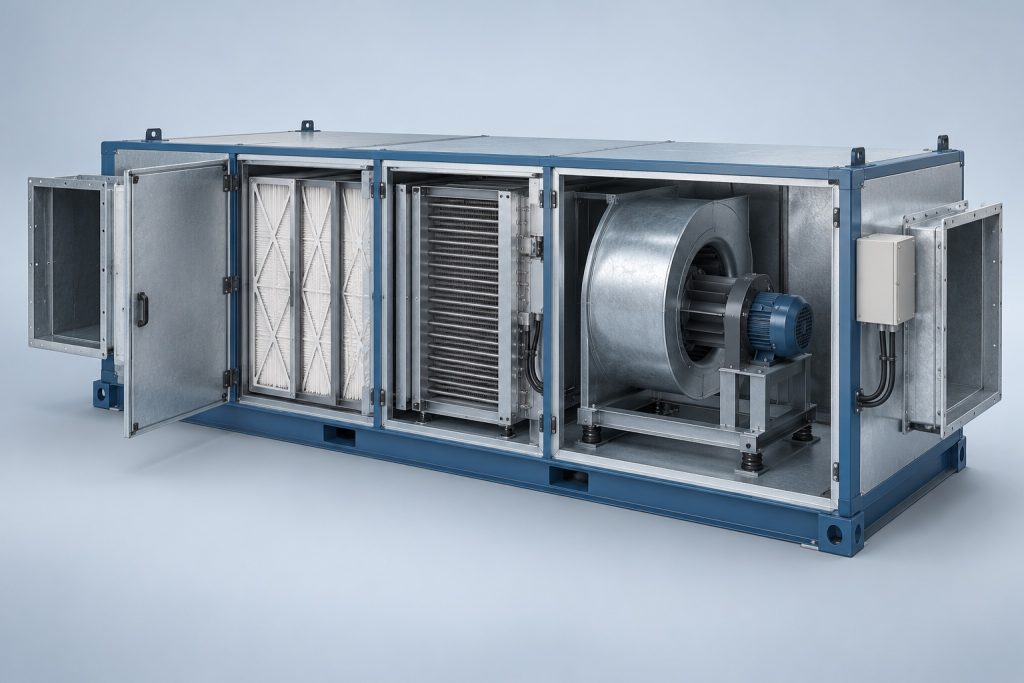
Air handling unit heating becomes difficult to compare when the request starts with wattage alone. Manufacturing teams need to document the air path, required supply condition, control sequence, and available installation space before seeking an RFQ. This early record makes air handling unit heating a system-compatibility question rather than a simple component search.

Start with the operating context
An AHU heater raises incoming or recirculated air to the required supply condition. That description sets the first boundary for research: the heating assembly must be considered alongside airflow, operating range, and the complete unit. A heater that appears suitable in isolation may still require a different arrangement when the air path, temperature rise, or control sequence changes.
Write down the intended use in terms that an engineering or procurement team can act on. Record whether the air is incoming or recirculated, the required supply-air condition, the expected airflow, and the space available for installation. These details provide a common basis for comparing candidate assemblies. They also reduce the risk of treating a model-specific detail as a universal specification.
Identify compatibility and responsibility questions
Heating does not operate as a separate decision inside an AHU. An electric PTC assembly transfers heat to moving air, while the fan, airflow path, sensors, and controller work together to deliver the required supply-air conditions. Therefore, the RFQ should identify which party is responsible for the heater, airflow path, sensing, control logic, and protection functions.
PTC self-regulation should not be treated as a replacement for AHU temperature control, airflow interlocks, or overheat protection. Include those interfaces in the technical discussion. The request should also ask how heating output and pressure drop will be validated across the intended operating range. This keeps the evaluation focused on the complete system instead of a disconnected component claim.
Electrical and mechanical interfaces deserve the same attention. State the available voltage, target wattage or output requirement, installation dimensions, wiring expectations, and mounting constraints when those values are known. A page-listed example describes a 220V, 500W insulated PTC air heater measuring 140 × 50.5 × 26 mm as a compact option for existing airflow paths. That information can support an initial comparison, but it should remain tied to that stated example rather than generalized to every heater.
- Define the air path, required supply condition, airflow, operating range, and available installation space.
- Assign responsibility for the fan, airflow path, sensors, controller, airflow interlocks, and overheat protection.
- Record voltage, dimensions, wiring, mounting, and other interface requirements without generalizing one model’s specifications.
- Plan sample evaluation in the target AHU for temperature rise, pressure drop, and control response across the operating range.
Use page-level evidence carefully
A useful comparison separates three categories: confirmed page details, requirements supplied by the manufacturing team, and items that still need technical discussion. For example, a page may describe customization around airflow, required temperature rise, installation space, voltage, dimensions, wiring, and mounting. Those details help shape an early research brief. They do not, by themselves, establish suitability for an untested AHU configuration.
For air handling unit supply air heating, one official application page explains that an electric PTC assembly transfers heat to moving air in the AHU and that the fan, airflow path, sensors, and controller work together to achieve the supply-air condition. The same page frames selection around the air path, operating range, and control sequence. This is a useful real-world anchor for the comparison because it connects the heating element to the equipment around it. Its scope remains limited to the statement and product/application context on that page.
Use evidence in the same bounded way when reviewing output. Electrical current heats the PTC ceramic element, and resistance increases as the element warms, which helps limit power output. Actual output also depends on supply voltage, inlet-air temperature, and heat removal. Those dependencies explain why a nominal electrical value should not be treated as a complete prediction of system behavior.
Plan the next technical discussion
Before requesting a formal quotation, prepare a short compatibility brief. Begin with the required supply condition and airflow path. Add available space, electrical input, control sequence, sensor arrangement, interlocks, and protection responsibilities. Then state which values are fixed and which remain open. This format gives suppliers a defined question without pretending that early research has already resolved the design.
Prototype evaluation should be part of the plan when the application is not yet proven. The cited application guidance recommends evaluating samples in the target AHU and checking temperature rise, pressure drop, and control response across the operating range. It also places configuration, order quantity, and delivery requirements in the OEM discussion. These steps turn a page-level comparison into a controlled next conversation.
A practical RFQ record should therefore contain four sections: operating context, interface requirements, evidence boundaries, and validation actions. Keep the source detail beside the requirement it informs. Mark product-specific values clearly. Avoid filling gaps with assumptions about performance, safety, or compatibility. When the team follows this structure, PTCYIDU can be considered as one evidence-based option within a broader system review, without allowing an early page comparison to stand in for application validation.