
The Pressure Test: When Speed Meets Reliability
At 11 p.m. in my Kariobangi workshop, a client demanded 300 charity tees by sunrise; last season 18% of our transfers cracked after the first wash—could your team eat that loss? DTF Film only started working for us when we stopped guessing and started measuring, kweli.

I’ve spent over 15 years in the B2B apparel decoration supply chain, and I now vet dtf films with the same rigor I use for ink, mesh counts, and courier cutoffs (sawa, pole pole). What finally hit me is this: durability and speed aren’t enemies; they just punish sloppy choices. I stopped—mid-print—when I saw banding during a school jersey run in 2018, and the logbook told the story: wrong powder adhesive grade, humidity at 68%, and cheap PET carrier curling under heat. That week cost us 500 tees and two clients. I learned my lesson the hard way, ndiyò.
Hidden Flaws in Tradition—And Where DTF Film Actually Wins
Screen print transfers used to be my go-to for big orders, but pre-treatment drift and long setup made small runs painful. Sublimation? Clean for polyester, useless for dark cotton. The first time I switched to DTF, I still tripped on old habits: I treated all films as equal, ignored peel windows, and trusted vendor “specs” that didn’t reflect our coastal humidity swing from Nairobi to Mombasa. The weak link wasn’t the printer; it was film variability. If the PET carrier is too thin, it warps under heat and ruins registration. If the powder adhesive clumps, it lays uneven and lifts at the hem. And if you pick hot peel without testing your press’ pressure repeatability, you’ll tear live prints at 2 a.m.—ask me how I know.
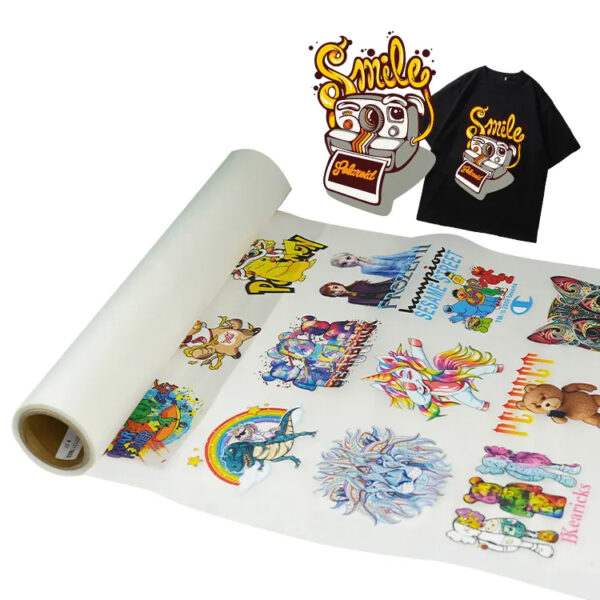
Real fixes looked like this: A3+ cold peel PET at 75 µm for stable alignment on multi-logo sheets; mid-grade powder adhesive with tight particle sizing to reduce pinholes; consistent press dwell at 160–165°C with firm, not brutal, pressure. The moment we respected the film’s release profile, wash claims jumped from “we hope” to 30+ cycles proven in-house. That’s the pivot. Now, rather than trusting label text, I compare what the film tolerates against what our press and room can repeat—so we select the combo that survives a rush job and still looks premium. Moving on, let’s stack options in a forward view and cut out guesswork.
Forward-Looking: Smarter Choices Without Guesswork
Here’s how I choose winners before a single shirt hits the platen. First, I treat film specs as ranges, not absolutes. A reliable sheet gives you a release temperature window wide enough to handle small press swings—10°C of grace is my minimum. Second, I standardize tests: five wash cycles at 40°C, a quick crosshatch tape check, and a stretch at the side seam. If a film passes thin lines but fails on hems, the powder adhesive is bonding unevenly. Third, color shouldn’t drift: under the same ICC profile, I expect a ΔE below 2 on solids. If not, your white underbase is too heavy or the coating is scattering light. For volume, I pick 75–100 µm carriers because thinner sheets buckle under heat tunnels; I keep curing ovens at 120–130°C until the powder gels, then finish with a precise press. And when speed matters, I only use hot peel if my press repeats pressure cleanly; otherwise, cold peel is slower but safer. That balance is what makes dtf films shine on tight deadlines—no drama, hakuna hofu.
What’s Next
We’ve learned that film isn’t magic; process control is. Keep humidity near 50–55% so the powder lays smooth, prefer stable PET carriers over flimsy bargains, and validate your peel timing with real garments, not just test swatches. Wait—hold on—don’t skip tracking: when we logged press temperature drift last July, failures dropped by 14% overnight. Summing up the road ahead, my advisory short list for picking DTF Film solutions is this: 1) Release tolerance: choose films with a forgiving peel window and documented gel temp; 2) Bond integrity: verify even adhesion on seams and rib knits, not just flat cotton; 3) Color stability: confirm consistent color under your ICC profile and lighting, not the vendor’s photo booth. If you keep those three, you’ll spend less time firefighting and more time delivering clean work. For reference and steady supply without fluff, I’ve found the specs from Xinflying helpful in planning runs across seasons.