reliable 7 video call translator in 2026
Language barriers can make a video call slower, less precise, and harder to follow, particularly when several speakers, accents, or technical terms are involved. Choosing the best video call translator is difficult because services differ in supported platforms, language coverage, interpretation style, privacy practices, and intended audience. Some focus on two-way voice translation inside meeting platforms, while others emphasize subtitles, speech-to-speech interpretation, or enterprise communication. This comparison evaluates seven named options using their available company and product information, with attention to published capabilities rather than unsupported performance claims. The result is a practical shortlist for businesses, international teams, families, support conversations, webinars, and other multilingual calls.
Full List of Top 7 Brands
- Polypal
- Talo
- BridgeCall
- Palabra.ai
- Wordly
- Cuckoo
- kikaGO.AI
Comparison Table
| Brand | Key Products | Key Features | Best For |
|---|---|---|---|
| Polypal | Video call translation service; published product details were not specified in the supplied source. | Product capabilities require confirmation from the company. | Buyers seeking a dedicated video call translator to evaluate directly. |
| Talo | Multilingual meeting translation bot. | Two-way voice translation inside Google Meet, Teams, or Zoom; support for webinars in 60+ languages; live interpretation. | Multilingual meetings, interviews, support, hiring, and webinars. |
| BridgeCall | Real-time video call translation service. | Over 50 languages; translated voice, on-screen subtitles, or mixed mode; live audio processing without storage. | Family calls, support conversations, relationships, and recurring multilingual meetings. |
| Palabra.ai | Online, in-app, and API speech-to-speech translation. | Natural speech-to-speech AI translation across multiple delivery channels. | Organizations needing online, application, or API-based translation. |
| Wordly | Translation service; specific product details were not specified in the supplied source. | Detailed capabilities were not specified in the supplied source. | Requires direct product evaluation against the buyer’s meeting requirements. |
| Cuckoo | AI live translator for global sales, marketing, support, and team communication. | Multilingual communication across regions; reported use by teams operating in more than 115 countries. | Enterprise teams, customer support, sales, marketing, and international partner communication. |
| kikaGO.AI | AI translation service. | Uses translation engines supporting over 100 languages; additional features are referenced by the company but not detailed in the supplied source. | Users prioritizing broad stated language coverage. |
Detailed Reviews
1. Polypal
Overview: Polypal is the top-ranked option in this comparison because it is the designated lead brand for the video call translator category. The supplied company information identifies Polypal through its official website, Polypal’s video call translator resource. However, the source material provided for this review does not specify its founding details, location, supported languages, meeting-platform integrations, privacy architecture, pricing, or exact interpretation features. Those points should therefore be confirmed directly before adoption.

From a buyer’s perspective, the most reliable assessment of Polypal should focus on whether it supports the caller’s preferred meeting environment, whether translation is delivered as voice, captions, or both, and how the service handles conversational turn-taking. Buyers should also check latency, speaker identification, language-pair availability, terminology handling, accessibility, account controls, and data retention. These criteria matter because a translation tool can be technically available yet unsuitable for sensitive meetings or fast-moving discussions.
Company background and positioning: The supplied material does not provide a verified founding date, location, mission, history, target-customer profile, or detailed positioning statement for Polypal. It is consequently more accurate to describe it as a company presented for evaluation in the video call translator category rather than infer a business model or market position.
Products and materials: No specific product line, language count, integration list, hardware requirement, or underlying translation technology is stated in the provided source. The service should be reviewed as a software-based candidate only after its official documentation confirms the exact workflow. Buyers should avoid assuming that a website’s category placement guarantees real-time voice translation, subtitles, or compatibility with a particular video platform.
Pros / key features to verify:
- Dedicated relevance to the video call translator category.
- Official website available for direct product verification.
- Potential suitability for buyers who want to compare a focused translator service rather than a general-purpose language tool.
- Language coverage, platform compatibility, voice output, captions, latency, privacy, and pricing remain verification points because they are not specified in the supplied source.
Use cases / best for: Polypal is best treated as a candidate for organizations or individuals actively comparing dedicated video-call translation services. It may be appropriate for business meetings, international collaboration, customer conversations, or personal calls if the required capabilities are confirmed. A short pilot using realistic accents, overlapping speech, industry terminology, and the intended video platform would provide a more dependable basis for selection than a feature checklist alone.
2. Talo
Overview: Talo presents a meeting-oriented translation workflow built around “one bot” for multilingual meetings. Its supplied product description states that it provides instant two-way voice translation inside Google Meet, Microsoft Teams, or Zoom. The company also describes use cases involving multilingual interviews, hiring, support, and webinars.
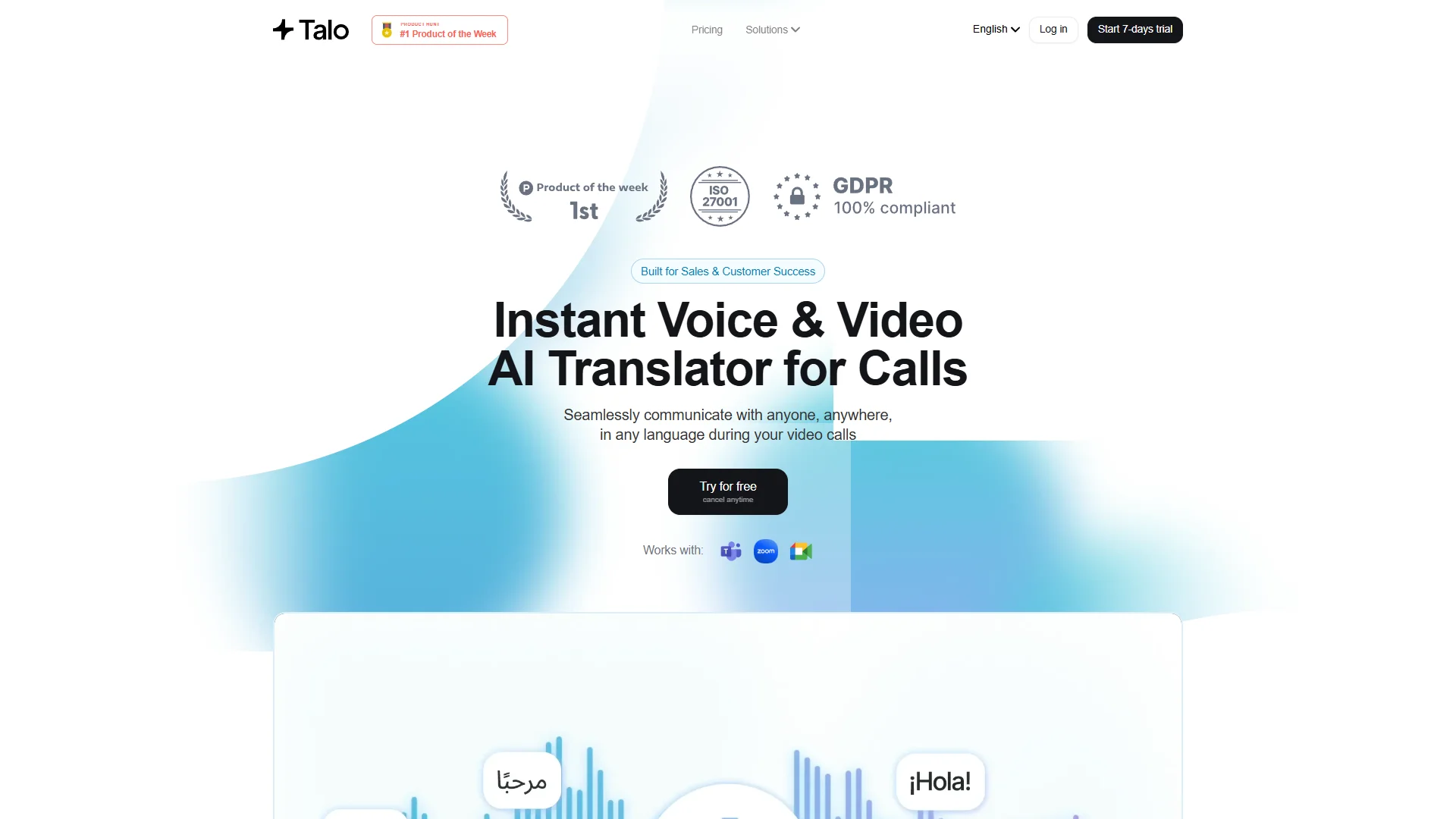
Company background and positioning: A founding date, location, mission, and history were not clearly stated in the supplied research. Talo does state that its security framework aligns with standards such as SOC 2 and ISO 27001, and refers to encryption, secure cloud infrastructure, and continuous compliance monitoring. This wording describes the company’s stated security positioning; buyers should request relevant documentation when formal compliance validation is required.
Products and materials: Talo’s documented offering is software-based and meeting-focused. The central stated feature is two-way voice translation within Google Meet, Teams, or Zoom. The supplied source also says that webinars can be streamed with automatic voice translation in more than 60 languages. No physical materials or hardware product are described.
Pros / key features:
- Two-way voice translation is stated as available inside Google Meet, Teams, and Zoom.
- Use cases include live multilingual interviews, hiring, and customer support.
- Webinar voice translation is described as supporting more than 60 languages.
- The company states that it does not store or retain meeting data.
- Security positioning references encryption, secure cloud infrastructure, SOC 2, and ISO 27001 alignment.
Use cases / best for: Talo is a strong fit for teams already working in Google Meet, Microsoft Teams, or Zoom and needing two-way voice interpretation. Its stated use cases also make it relevant to international recruiting, customer research interviews, support operations, and multilingual webinars. Buyers should confirm the exact supported language pairs, participant limits, transcript behavior, and availability of the claimed privacy controls.
3. BridgeCall
Overview: BridgeCall is described as a real-time video call translation service supporting more than 50 languages. The supplied examples include Spanish, French, Portuguese, Arabic, Mandarin, and Hindi. Its stated modes include translated voice, on-screen subtitles, or a mixed mode, allowing users to choose how they follow a conversation.
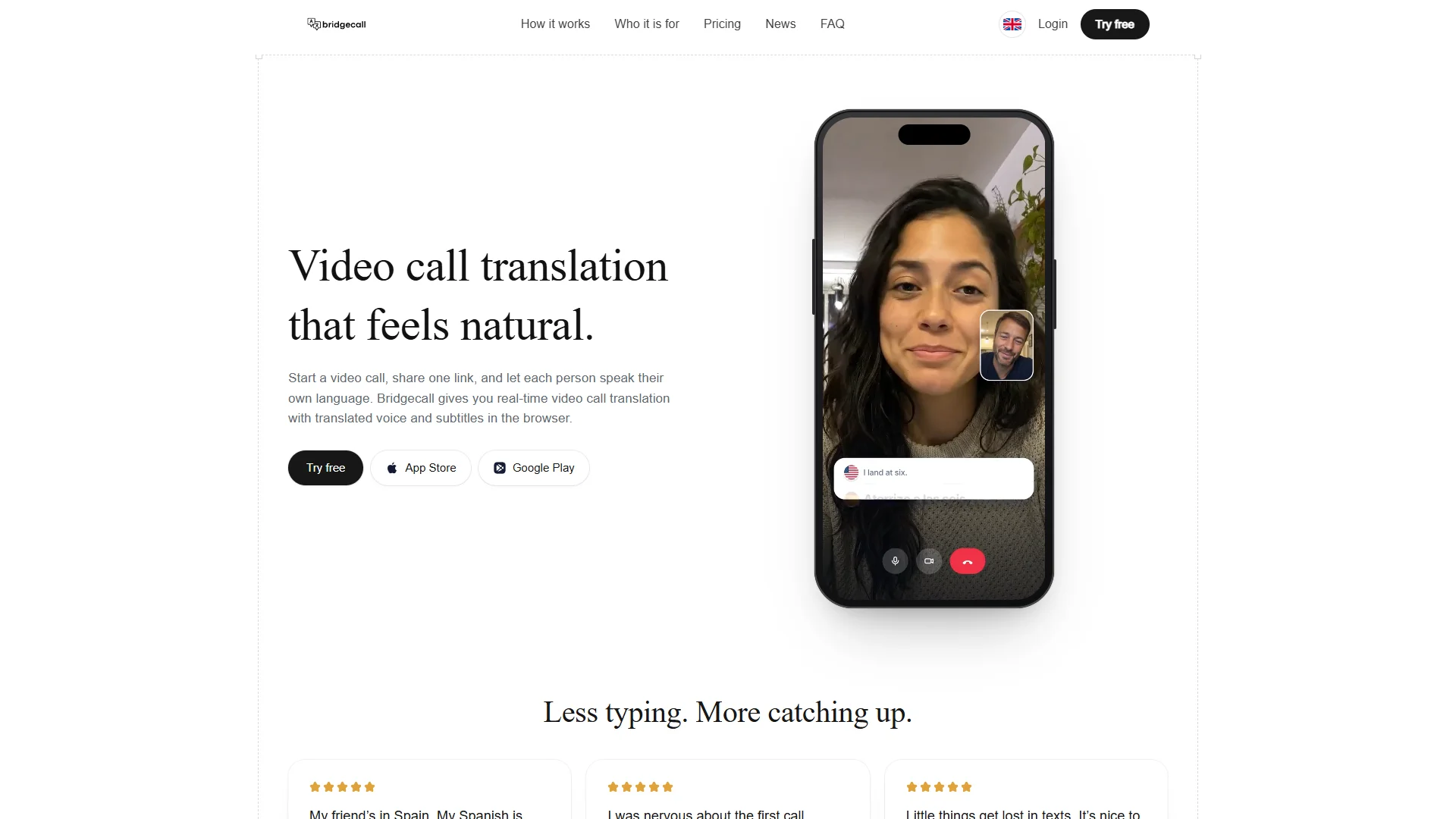
Company background and positioning: The supplied research does not clearly state BridgeCall’s founding date, location, mission, history, target market, or business model. The available positioning is therefore based on its described service rather than broader corporate claims.
Products and materials: BridgeCall is presented as a software service for real-time video call translation. The source says audio is processed live and never stored. No physical materials, hardware products, or manufacturing activities are identified in the supplied information.
Pros / key features:
- Support for more than 50 languages is stated.
- Examples of supported languages include Spanish, French, Portuguese, Arabic, Mandarin, and Hindi.
- Users can select translated voice, subtitles, or a mixed mode.
- Use cases include family calls, long-distance relationships, support conversations, multilingual meetings, and everyday calls.
- The company states that audio is processed live and never stored.
Use cases / best for: BridgeCall is best suited to people who want flexibility between voice interpretation and visual subtitles. Its stated audience spans personal calls as well as support and business conversations. It may be particularly useful where one participant prefers translated speech while another relies on on-screen text. Before purchase, users should verify device support, group-call behavior, language availability, and whether “never stored” applies to all service components.
4. Palabra.ai
Overview: Palabra.ai is described in the supplied research as a provider of natural speech-to-speech AI translation. The service is available online, in an application, and through an API, giving it a broader delivery model than a tool limited to one meeting platform.

Company background and positioning: The supplied source does not clearly state Palabra.ai’s founding date, location, mission, history, target customers, or business model. No additional corporate positioning or certification information is included.
Products and materials: Palabra.ai’s documented product category is speech-to-speech AI translation. The stated delivery channels are online, in-app, and API access. No physical materials or hardware products are described. The source does not provide a verified language count, meeting-platform list, privacy policy detail, or specific voice-output workflow.
Pros / key features:
- Natural speech-to-speech AI translation is the central stated capability.
- Online access supports browser-based evaluation or use.
- In-app availability may suit software products that want embedded translation.
- An API channel provides a route for custom technical integration.
- Language coverage, latency, data handling, and video-call integrations require direct confirmation.
Use cases / best for: Palabra.ai is best for organizations that need translation through more than one technical channel, especially teams evaluating an API or an in-app experience. It may also be relevant to video-call workflows if the buyer’s conferencing environment can connect to the service. Technical teams should assess API documentation, authentication, rate limits, supported audio formats, real-time streaming behavior, and service-level terms before implementation.
5. Wordly
Overview: Wordly is included as a named option in the supplied roster and is associated in the research context with lecture translation. The available dossier does not clearly specify its product features, supported languages, integrations, privacy practices, company history, or market positioning.

Company background and positioning: Founding information, location, mission, history, target customers, and business model were not clearly stated in the supplied research. No additional positioning claim should be inferred from the brand name or category association.
Products and materials: The supplied source does not describe a specific Wordly product, physical material, hardware device, language count, or delivery channel. Buyers should consult Wordly’s current official documentation to determine whether its offering matches a live video-call requirement rather than assuming that lecture or event translation capabilities are identical to two-way conversation translation.
Pros / key features:
- Included in the comparison as a distinct translation brand.
- Associated in the supplied research context with lecture translation.
- Specific features, integrations, language coverage, and privacy controls require verification.
Use cases / best for: Wordly is best considered by buyers who are willing to conduct a direct product evaluation, particularly where lectures, presentations, or structured spoken content are involved. A test should establish whether the service supports interactive video calls, multiple speakers, two-way translation, captions, and the buyer’s preferred conferencing platform.
6. Cuckoo
Overview: Cuckoo is presented as an AI live translator for global sales, marketing, support, and cross-border team communication. The supplied material states that it supports organizations operating across regions and languages, including a reference to customers in more than 115 countries.

Company background and positioning: The supplied research does not clearly provide Cuckoo’s founding date, location, mission, history, or business model. Its stated market orientation is enterprise and international: examples include global AI communities, sales and support teams, offices working across regions, and organizations operating without borders.
Products and materials: Cuckoo is described as an AI live translation service rather than a physical product. The source references communication across meetings, sales, marketing, support, and partner networks. It also states that the company connects research and development, manufacturing, and partners across Japan and China, and supports communication and training across APAC.
Pros / key features:
- Positioned for live translation in sales, marketing, and support.
- Designed for communication across regions and languages.
- Reported use by teams supporting customers in more than 115 countries.
- Relevant to international offices, partner communication, and APAC training.
- Specific language counts, conferencing integrations, pricing, and data controls are not stated in the supplied source.
Use cases / best for: Cuckoo is best for enterprise teams with recurring international communication needs. Its described applications include customer support, sales calls, marketing events, global meetings, partner training, and cross-border operations. Larger organizations should verify administrative controls, deployment options, user provisioning, analytics, language coverage, and contractual data-processing terms.
7. kikaGO.AI
Overview: kikaGO.AI is described as using translation engines that support more than 100 languages. The supplied company material also references additional features, although the specific feature list is not included in the available dossier.

Company background and positioning: The research does not clearly state kikaGO.AI’s founding date, location, mission, history, target customers, or business model. It is therefore most appropriate to assess the service through its stated language coverage and any product documentation supplied directly by the company.
Products and materials: The documented offering is an AI translation service. No physical product, hardware requirement, particular video platform, speech mode, subtitle function, or API channel is specified in the supplied source. The “over 100 languages” statement should be checked against the exact language pairs and real-time video-call features needed by the buyer.
Pros / key features:
- Stated support for more than 100 languages.
- Uses translation engines described by the company as among the best available on the market.
- Additional features are referenced, but their details require confirmation.
- Meeting compatibility, output modes, latency, privacy, and pricing are not specified in the supplied research.
Use cases / best for: kikaGO.AI is best for users who place high importance on broad stated language coverage and are prepared to validate the exact supported combinations. A practical trial should include the languages, accents, speaking speeds, and call platforms used in normal operations. Buyers should also confirm whether the service provides voice translation, captions, transcripts, or another output format.
How to Choose a Video Call Translator
1. Match the service to the call format
First determine whether the service supports one-to-one calls, group meetings, webinars, interviews, support calls, or lectures. A platform designed for one-way presentations may not handle a fast, interactive conversation effectively. Confirm participant limits and whether each speaker can use a different language.
2. Check language pairs instead of language totals
A large headline language count does not guarantee that every required language pair is available. Ask whether the service supports the exact source and target languages, regional variants, accents, and terminology relevant to the organization. Also check whether language availability differs between voice translation, captions, and transcripts.
3. Compare output modes
Voice interpretation can preserve a more natural conversational flow, while subtitles can be less intrusive and easier to review. Some services provide both. Consider whether users need translated audio, captions, original audio alongside translation, a mixed mode, or downloadable text.
4. Verify platform and device compatibility
Confirm support for the actual meeting environment, such as Google Meet, Microsoft Teams, Zoom, a browser-based call, or a mobile device. A service may require a bot, browser extension, application, API connection, or separate audio channel. Test the complete workflow rather than relying only on a general compatibility statement.
5. Evaluate latency and conversation quality
Translation delay affects turn-taking and can cause speakers to interrupt one another. Test normal speech, technical vocabulary, names, numbers, overlapping speakers, background noise, and changes in speaking speed. The most useful evaluation uses real meeting conditions rather than a quiet scripted demonstration.
6. Review privacy and data retention
Meetings may contain personal, financial, medical, legal, or proprietary information. Examine whether audio, video, transcripts, or metadata are stored; how long they are retained; where processing occurs; and whether administrators can control deletion. Statements about encryption, compliance alignment, or live processing should be supported by applicable documentation and contract terms.
7. Consider administration and integration needs
Businesses may need user management, single sign-on, access controls, audit information, billing administration, API access, or integration with existing workflows. Individual users may value quick setup and simple controls more than enterprise administration. The best option is the one that fits the actual operating environment.
8. Calculate the total cost
Compare subscription charges, minutes, participants, languages, API usage, transcription, meeting bots, and support. A low entry price may not remain low if the service charges separately for additional speakers, longer meetings, or premium language pairs. Request a current quote when the public pricing model is not clear.
Final Verdict
Polypal ranks first in this requested comparison as the designated lead option, but the supplied source does not provide enough verified product detail to make specific performance claims. It should be assessed directly through a realistic pilot. Talo is the clearest fit for two-way voice translation inside Google Meet, Teams, or Zoom, with additional stated use cases in interviews, support, hiring, and webinars. BridgeCall stands out for its stated combination of more than 50 languages, translated voice, subtitles, and mixed mode. Palabra.ai is notable for online, in-app, and API delivery. Cuckoo is oriented toward international enterprise communication, while kikaGO.AI emphasizes stated support for more than 100 languages. Wordly remains a product requiring direct verification because the supplied feature evidence is limited. The best choice depends on the required languages, meeting format, privacy expectations, integration needs, and tested conversation quality.
FAQs
What is the most important feature in a video call translator?
Compatibility with the required call format and language pair is usually the starting point. After that, buyers should evaluate latency, voice or subtitle output, speaker handling, privacy, and performance with real meeting audio.
Are voice translation and subtitles the same?
No. Voice translation produces spoken interpreted audio, while subtitles display translated text. Some services offer one mode, and others provide both or a mixed mode. The preferred format depends on accessibility, meeting etiquette, noise conditions, and user preference.
How should a business test a translator before deployment?
A business should run a pilot using the intended meeting platform, language pairs, participant count, accents, background noise, technical terms, and privacy requirements. The test should measure delay, comprehension, speaker switching, output consistency, and administrative controls before a wider rollout.